

The lunch bags are back in the cupboard and the school run has started again. The jewellery trade is back at its desk, wondering where the summer went. Here is what actually happened in the Canadian jewellery market between the Toronto shows and Labour Day, and what it means for the space you are about to commit before Christmas.
Welcome back. Only a few weeks remain before the fourth quarter begins. That means you are writing the holiday buy now, against a market that changed direction more than once while Canadian buyers were on the road.
Here is the Canadian jewellery market’s summer 2026 report card: what changed, what the public data actually supports, and what deserves attention before holiday inventory is committed.
The season started in Toronto, not Las Vegas
The American trade tends to date its year from Las Vegas. The Canadian calendar began earlier. Time & Shine Toronto opened on 26 and 27 April, JCK followed at the end of May. Time & Shine Edmonton ran on 16 and 17 August, and Expo Prestige Montréal closed the summer on 23 and 24 August.
Four trade shows, three of them Canadian. Keep that sequence in mind while reviewing orders. Decisions made in April and May rested on metal prices, exchange rates and demand assumptions that did not stand still.
Vegas showed a widening market
JCK ran from 29 May to 1 June at the Venetian Expo, with Luxury beginning on 27 May. The show’s own reporting points to a large, active international floor, but the most useful takeaway for Canadian retailers was not the attendance count. It was the widening gap between high-end demand and the more price-sensitive middle.
That split changes the buying question. The goal is no longer simply to find lower prices. It is to build a clearer ladder: lighter and more accessible pieces at one end, distinctive high-value pieces at the other, and fewer products stranded in an undifferentiated middle.
Gold fell sharply, then recovered
Gold’s summer movement is easy to remember incorrectly because the longer trend has been so strong. The World Gold Council recorded a late-June dip below US$4,000 an ounce after gold had set repeated highs above US$5,500 earlier in the year. Its July commentary put the month-end price near US$4,027, essentially unchanged for July, before prices recovered toward US$4,400 in August.
The important issue for a jewellery store is not predicting the next move. It is knowing how that movement reaches the invoice. When weight, karat and making charge are visible as separate figures, a buyer can see what changed. A single fixed piece price hides all three.
Holiday inventory is committed before anyone knows where gold will sit in November. That makes transparent costing and frequent ticket review more useful than a confident forecast.
Silver is no longer the simple alternative
Silver’s volatility makes the old “gold is expensive, push silver” reflex less dependable. The LBMA reported that silver reached US$118.45 on 29 January, then ended June at US$58.80 after falling more than 21 per cent during the second quarter.
Platinum presents a different story. It remains materially below gold, which gives retailers a credible white-metal value argument as well as a prestige argument. Pandora’s decision to introduce platinum-plated jewellery is not a direct comparison with solid platinum fine jewellery, but it is a useful signal that large manufacturers are reconsidering their dependence on silver.
Natural diamond prices stabilized in July
After more than a year of declines, July brought a measurable change. Rapaport reported flat or positive results across its four major diamond categories: 0.30-carat stones rose 1.6 per cent, 0.50-carat stones rose 1.8 per cent, one-carat stones were flat after thirteen consecutive monthly declines, and three-carat stones edged up 0.2 per cent.
Stabilization is not the same as a broad demand recovery. Supply is also contracting. De Beers’ first-half results showed rough sales of US$1.3 billion, an average realized price of US$105 per carat, and plans to pause production at Venetia for two years. For Canadian buyers, the practical conclusion is modest: review the cost of small natural goods now instead of assuming last year’s price remains available.
Lab-grown is a category to sell carefully and own lightly
Lab-grown diamonds still serve real customers, but falling wholesale values make deep ownership harder to defend. Memo, consignment and disciplined stock levels can keep the category available without turning every price adjustment into an inventory write-down.
Retail sales language also needs to stay current. Since October 2025, the GIA has assessed qualifying D-to-Z laboratory-grown diamonds as “Premium” or “Standard” rather than using the natural-diamond grading nomenclature. Stones below the Standard criteria do not receive that assessment. A sales presentation built around an older report format should be reviewed before the holiday season.
The 50 per cent US tariff, in practical terms
Current US Section 338 measures impose additional duties on specified Canadian-origin goods entering the United States. They do not apply to every Canadian product or to ordinary domestic purchases. The White House states that covered goods remain subject regardless of USMCA origin, but coverage depends on the precise tariff classification.
Canada’s counter-tariffs take effect on 8 September and apply to a separate list of US products entering Canada. Any jeweller shipping finished pieces, repairs or custom work across the border should confirm the applicable classification and treatment with a customs broker before quoting the customer.
Canadian Jewellery Market Data Needs Careful Reading
Statistics Canada reported total retail sales of $74.3 billion in June, up 0.6 per cent from May. The category containing clothing, accessories, footwear, jewellery, luggage and leather goods rose 3.1 per cent.
That broad category is encouraging context, but it is not jewellery-only proof that unit volume rose or that the average jewellery ticket fell. Those more specific conclusions require a separate jewellery dataset. The safer operational signal comes from the sales floor: watch whether customers are moving toward lighter gauges, lower karats and more accessible price bands, then build the assortment around what the store can actually demonstrate.
What deserves space before Christmas
Looking across the season, five buying ideas are worth testing against your own customer data:
- Charms and interchangeable carriers. A pendant that can move between a gold chain, leather cord or bead strand gives the customer more control over the final ticket.
- Tennis bracelets and enduring bracelet formats. Familiar silhouettes make precious-metal value easier to understand.
- Coloured stones and pearls. They offer visual distinction without making the entire design depend on metal weight.
- Yellow gold. It remains central, but weight, gauge and karat now matter as much as style.
- A karat ladder rather than one “correct” price point. Ten, fourteen and eighteen karat give the retailer more ways to preserve design intent while meeting different budgets.
What DIORO built this summer
We walked JCK asking the same question as every Canadian buyer: what do we need to travel farther to find? The answer was encouraging. Gold chains, lightweight 18kt, natural and lab-grown programmes, and everyday luxury were already available much closer to home. The real need was depth, clarity and speed.
June brought the DIORO Findings Division: clasps, jump rings, posts, butterfly backs, bails and graduated seat sizes in solid gold. Alongside it, DIORO Bespoke provides white-label custom work from CAD through casting, setting and finishing.
Since 1 September, DIORO has quoted findings by weight rather than by the piece: metal at the day’s market in 10kt, 14kt or 18kt, with the making charge shown separately. In a season when gold moved sharply in both directions, two visible numbers can be checked against reality. One bundled number cannot.
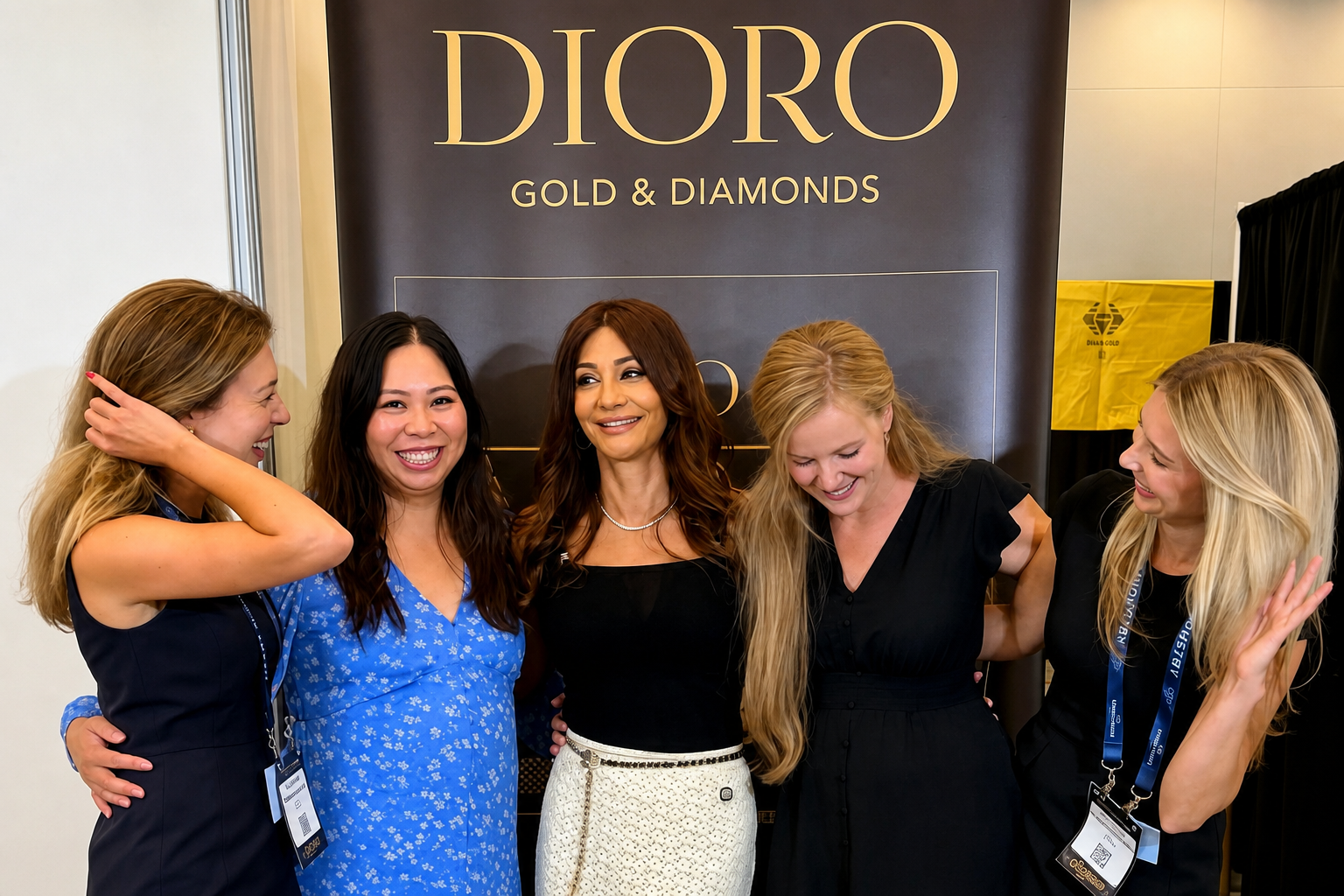
DIORO also travelled from Toronto to Edmonton and Montréal with its largest collection taken west, and was named Wholesaler of the Year at the 2026 Canadian Jeweller Awards of Excellence.

If you are holding the buy back, know when the door shuts
Holding part of the holiday budget until November can be sensible. Six weeks of real traffic is more useful than an August forecast. The risk is lead time: much of what gets ordered in November arrives too late to earn its place in the fourth quarter.
Time & Shine Toronto on 1 and 2 November 2026 is a delivery show, built around goods that leave the floor with the buyer. For retailers who deliberately reserve part of the holiday budget, it is the final Canadian opportunity this year to restock live goods and still sell them in the quarter in which they were purchased.
Eight actions for the Q4 buy
- Review gold-linked tickets weekly instead of quarterly.
- Build a clear 10kt, 14kt and 18kt ladder before chasing discounts.
- Keep essential findings in stock; keep lab-grown ownership disciplined.
- Recheck the cost of small natural diamonds.
- Merchandise the carrier separately from the pendant.
- Give customers a credible white-metal option.
- If you ship south, obtain the tariff position from a customs broker.
- Mark 1 and 2 November as the final live-goods buying dates of the year.
Plan the Q4 buy with clearer numbers. Request DIORO’s current findings and chain linesheets or book a private viewing at the Toronto showroom through the contact page.