

Repricing gold is the least glamorous job in a jewellery store, and this year it decided who sold a chain and who did not. Two stores on the same street bought the same 8mm Cuban in February.
Same chain, same weight, same supplier. Both tagged it that week, when gold was C$6,858 an ounce.
In July, one of them re-tagged it. The other did not. There was no reason to. The chain had not sold, and the number on it was the number he had paid for.
Last Saturday, a customer walked into both.
She was not comparing service, or the showcase, or which of them had been on that street longer. She was comparing two numbers, and one of them was written when gold cost C$800 more an ounce.
Gold was C$6,045 an ounce that week. Repricing gold jewellery in a year like this one is not complicated, but it does ask you to think about your stock as capital rather than as inventory, and most of us were never taught to.
Nobody Ever Taught You to Re-Tag Downward
Here is the part worth sitting with: the jeweller who did not re-tag was not being careless.
He was doing what the trade taught him. Gold goes up, you reprice. Everyone knows that one. Every article, every rep, every supplier letter for twenty years has been about protecting margin against a rising metal.
Nobody ever taught anyone to go the other way.
So a price tag became a thing that only ever climbs, and 2026 turned out to be the year that habit cost money. Not by giving away margin, which is the failure everyone is trained to see. By making you expensive, which is the one nobody checks for.
An expensive chain does not sell. A chain that does not sell ages. And an aged chain gets marked down eventually anyway, in a worse mood, for less.
What Gold Actually Did This Year
Gold peaked on January 28 at C$7,344.62 an ounce, bottomed in July, and has come partway back. Here is that arc translated into the only thing that matters at the counter: the metal sitting inside one 10kt 8mm solid Cuban.
| Date | Gold, CAD per ounce | Metal in one GDOV250 (89.1g) |
|---|---|---|
| January 28, peak | C$7,345 | C$8,752 |
| February average | C$6,858 | C$8,173 |
| July average | C$5,748 | C$6,850 |
| September 23 | C$6,045 | C$7,204 |
Peak to trough, that single chain shed C$1,903 of metal value. Then it gained C$354 back between July and September.
Hold on to that second number, because it is the one that stops this article from being reckless advice. We will come back to it.

Meanwhile your customer is buying less metal for more money. Global gold jewellery volume fell 17 per cent year over year in the second quarter, the lowest quarterly tonnage since the pandemic, while spending on that smaller pile rose 14 per cent to US$40 billion, according to the World Gold Council.
Every Piece in Your Showcase Has Two Prices
This is the idea the rest of the article rests on, and it is the one most pricing conversations skip.
The chain in your showcase has a cost basis: what you paid in February. It also has a replacement cost: what the same chain would cost you this morning. In February those were the same number. Today they are C$8,173 and C$7,204.
Almost every instinct you have says to price off the first one. You paid it. It is on the invoice. Pricing below it feels like taking a loss.
It is not. The loss already happened.
It happened quietly, in the market, over seven months, and no decision you make now recovers it. The C$968 left when gold fell. Your only remaining choice is whether you also keep the chain.
Price it off February and you are holding an asset at a number the market no longer supports, hoping someone pays yesterday’s price for today’s metal. Price it off this morning and you are competitive, you free the cash, and you buy the replacement at the same lower market you just sold into. Your margin on the work is identical either way.
Accountants call the first mistake sunk cost. Jewellers call it the chain that has been in the showcase since spring.
Your Multiplier Is Doing Something You Didn’t Ask For
There is a second, quieter leak, and it is in the arithmetic rather than the psychology.
Say you price the way most stores do: add up what a piece cost you, apply a multiplier, that is the tag. Take the same 8mm Cuban, add a making charge of C$450, and keystone the total at two times.
| Cost | Tag at 2x | Your dollar margin | |
|---|---|---|---|
| February | C$8,623 | C$17,245 | C$8,623 |
| September 23 | C$7,654 | C$15,309 | C$7,654 |
| Change | C$968 | C$1,937 | C$968 |
Read the Last Row Twice
The cost change and the margin change are the same number. The tag change is nearly twice it.
So the multiplier handed the whole metal movement to the customer twice over, and took it out of what you earn on the chain, even though nothing about your work got cheaper. You still cased it, insured it, polished it and sold it.
A blanket multiplier does not pass the metal through. It multiplies the metal’s movement and settles the difference out of your labour margin. On the way up it does the reverse and quietly prices you out of the sale.
The fix is to stop treating the tag as one number. Pass the metal through at cost, or cost plus a small handling margin, and let it move with the market. Hold your own margin on the work, in dollars, where it belongs. Then gold can do whatever it likes and your earnings on the making do not move with it.
For the metal line you need three figures and nothing else:
| Karat | Gold content | Gold value per gram, September 23 |
|---|---|---|
| 10kt | 41.6 per cent | C$80.86 |
| 14kt | 58.3 per cent | C$113.32 |
| 18kt | 75 per cent | C$145.77 |
This is the same logic behind quoting findings by weight rather than by the piece, pointed at your own counter instead of your purchase order.
Repricing Gold: Where the Line Actually Sits
Most advice on this subject says to reprice the heavy pieces often and the light ones rarely, then leaves you to guess where heavy begins. The threshold is not a matter of taste. It falls out of your own pricing increment.
Your tags almost certainly round to something. Call it C$25 or C$50. A metal movement smaller than that increment cannot change a tag, so re-tagging that piece is work with no output.
So ask how many grams it takes for a normal week of gold to clear your rounding.
| If a week moves gold | To clear C$25 you need | To clear C$50 you need |
|---|---|---|
| 1 per cent | 31g of 10kt | 62g of 10kt |
| 2 per cent | 15g of 10kt | 31g of 10kt |
| 3 per cent | 10g of 10kt | 21g of 10kt |
That is where the familiar 20-gram rule of thumb comes from, and now you can see it is not a rule at all. It is the middle of a range that depends on how coarsely you price and how much gold is moving that month.
Round to C$25 in a volatile month and your line is nearer 10 grams. Round to C$50 in a quiet one and it is past 60. Set your own and write it down, because a threshold you chose is a threshold you will actually follow.
What Seven Months of Gold Did to One Showcase
Same chains, same weights, two dates. This is the spot gold content in each piece in February and on September 23.
| 10kt chain | Width | Weight | Gold, February | Gold, Sept 23 | Change |
|---|---|---|---|---|---|
| GDOV080 | 2.5mm | 10.1g | C$926 | C$817 | C$110 |
| GDOV120 | 4mm | 21.6g | C$1,981 | C$1,746 | C$235 |
| GDOV150 | 5mm | 34.6g | C$3,174 | C$2,798 | C$376 |
| GDOV180 | 6mm | 48.0g | C$4,403 | C$3,881 | C$522 |
| GDOV250 | 8mm | 89.1g | C$8,173 | C$7,204 | C$968 |
| GDOV310 | 10mm | 133.0g | C$12,199 | C$10,754 | C$1,445 |
| GDOV450 | 15mm | 344.9g | C$31,636 | C$27,887 | C$3,748 |
| Miami 200 | 8mm hollow | 28.2g | C$2,587 | C$2,280 | C$306 |
The top three rows are inside most people’s rounding, which is the threshold argument made concrete. The bottom four are where the money is: a single 15mm Cuban carries almost C$3,750 of movement, and three of them in a showcase is more money than most stores make on a good December weekend, moving without anyone touching a thing.
The Real Question Is Cash, Not Margin
Margin per piece is the number everyone watches. It is not the number that decides whether a store has a good year.
Look at the last two rows of that table again as a cash decision rather than a pricing one. The 8mm hollow Miami reads the same width on a neck as the solid Cuban and holds about C$2,280 of gold against the solid’s C$7,200.
Which means the cash tied up in one solid Cuban would instead buy three hollow ones, with change.
Three chains on the wall rather than one. Three customers who find their size and style rather than one. Three chances to turn that capital over this quarter instead of one, and roughly a third of the price-move exposure on each of them.
That is not an argument for stocking only hollow, and a store with no heavy Cuban in the showcase loses the customer who came in for exactly that. It is an argument for knowing which pieces are earning their shelf space and which are simply storing gold at your expense. In a flat market that distinction is academic. In a year that moved C$1,900 through one chain, it is the difference between a showcase that works and a vault that happens to have a window.
You Are Also Short the Canadian Dollar
One layer further down, and worth a minute because almost nobody in the trade thinks about it.
Gold trades in US dollars. You buy and sell in Canadian ones. So the price on your tag is really two prices multiplied together, and they do not always move the same way.
Since January, gold fell about 22 per cent in US dollars but only about 18 per cent in Canadian dollars. Same metal, same seven months. The gap is the Canadian dollar weakening by roughly five per cent, which quietly took back about a fifth of the fall before it ever reached your invoice.
This cuts both ways, and that is the point. A weaker loonie has been cushioning Canadian jewellers all year. If it strengthens, Canadian gold prices will fall faster than the world’s, and a store still carrying February tags will find itself uncompetitive twice over.
You cannot hedge that, and you should not try. But you should know it is there, because it explains the thing that otherwise looks like a mistake: why your landed cost has not fallen as far as the headlines said it would.
Your Supplier’s Pricing Model Is Your Hedge
Here is the structural point, and it is the one we would want a buyer to take away even if they never order from us.
If your supplier prices metal off the day’s market, your replacement cost tracks the market. Gold falls, your cost falls, you re-tag down, and your margin on the work is untouched. Gold rises, the same thing happens in reverse. You are naturally hedged, because the two sides of your ledger move together.
If your supplier sells off a printed piece-price list, you are not.
A printed list has to survive a stretch of market movement, so it is set with a buffer above metal cost. Rising gold eats the buffer and triggers a reissue. Falling gold triggers nothing, because no mechanism in the world forces a price list downward. So your cost sits frozen at the top of the range while the market, and the store down the street, move below you. Re-tagging then genuinely does cost you margin, and the instinct not to do it is correct.
That is worth being precise about. In a falling market, a store buying by weight can reprice for free. A store buying by the piece cannot. The difference is not service or terms or how long anyone has been in business. It is arithmetic, and it only becomes visible in a year like this one.
DIORO prices many items on the real-time gold value, which is the whole reason the portal shows it. Ask any supplier the same question before your next order: when gold falls ten per cent, what happens to my cost, and when?
The Weights Are Already Printed
None of the arithmetic above takes twenty minutes unless somebody has already done the measuring. Somebody has.
Every chain in the DIORO catalogue carries its gram weight at 20 inches. Solid Cubans from GDOV080 at 2.5mm and 10.1g up to GDOV450 at 15mm and 344.9g. Hollow Miami Cubans the same way, Miami 180 at 19.0g through Miami 250 at 46.0g. CZ studs pair by pair, CE00 at 0.5g to CE05 at 2.7g. Wedding bands with a width and a weight for every reference.
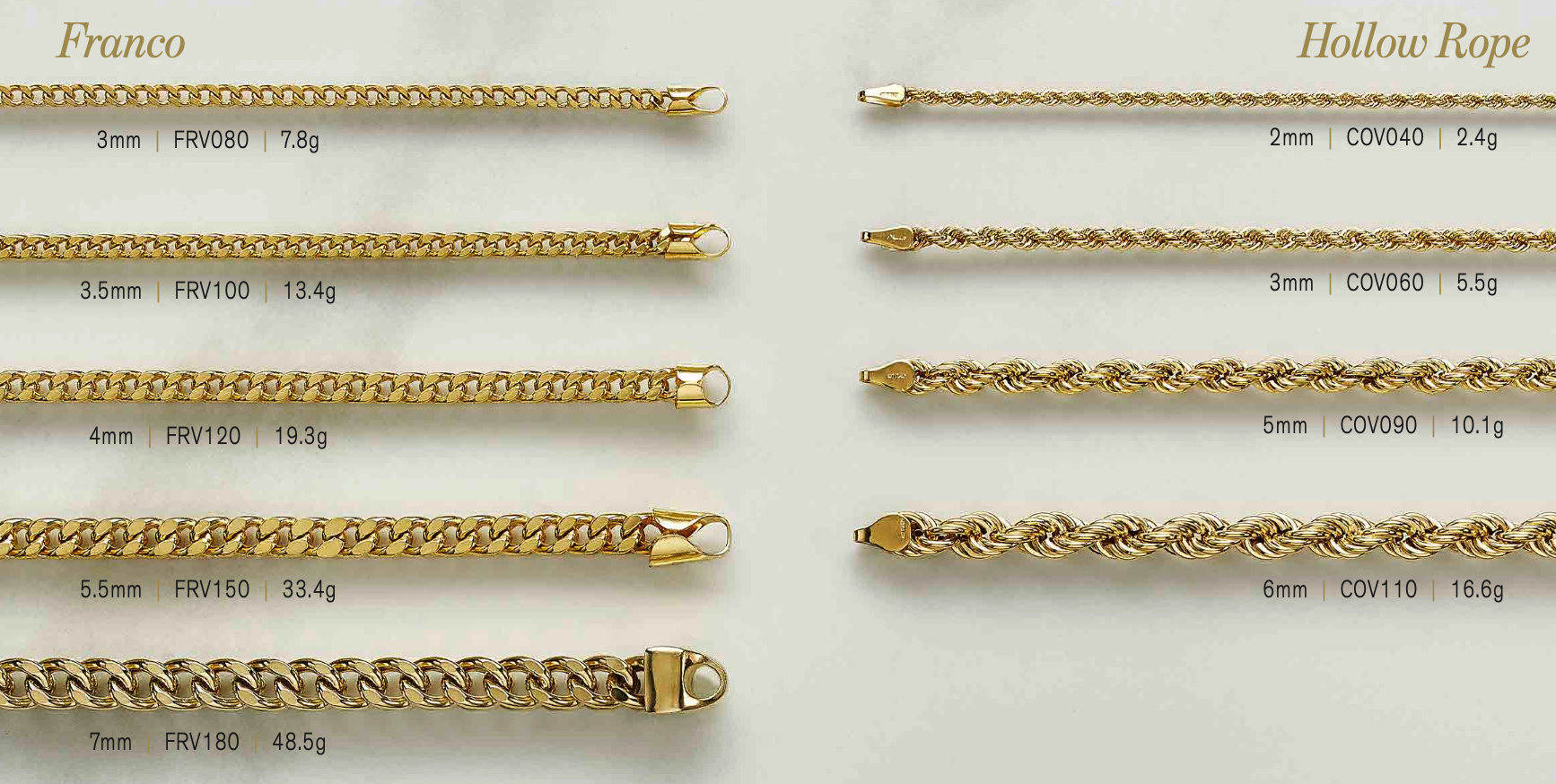
Put those weights in a column, put the day’s gold price in one cell at the top, and the whole chain wall reprices itself. Add a column for the date you last touched each tag and you have the entire system.
For Made-to-Order, Name the Moment It Locks
Stock in the showcase is the easy half. The hard half is anything you quote today and hand over in three weeks.
A 14kt WB001 band is 7mm and about 13 grams, so roughly C$1,473 of gold today. At January’s peak it was closer to C$1,790. Three weeks of September movement alone is worth about C$92 on that one ring.

So put it in writing. How long the quote holds, and seven days is defensible where thirty is a gift to whichever way the market runs. What locks it, whether that is a deposit, an approved design or the order going in, chosen once and used every time. And what happens if gold moves before the lock, in one line, which beats an awkward phone call.
Whatever you choose, apply it to your own layaways and special orders too. A price-protection promise made in February on a piece not yet delivered is a position in the gold market, and it is one you took without meaning to.
When a Customer Quotes the Headline at You
This is going to happen more as the year goes on, so it is worth having the answer ready rather than improvising it.
She has read that gold is down more than twenty per cent. She is standing in front of a ring that is not down twenty per cent, and she would like to know why.
The honest answer is arithmetic, and the split tag is what lets you give it.
Only the metal line moved. On a plain 14kt band, metal might be three quarters of the cost, so an 18 per cent fall in gold takes something like 13 per cent off the ticket. On a diamond piece where the stones and the setting do most of the work and metal is under a third of the cost, the same 18 per cent fall takes about five per cent off. Nothing happened to the diamonds, the labour, the rent or the insurance.
A store that can walk a customer through that in two sentences sounds like it knows what it is selling. A store that says “gold is gold” sounds like it is hoping she does not push.
The Gold in Your Safe Is Moving Too
Every trade-in and scrap lot on the shelf is priced at the day you took it in. Gold bought in February is holding about 12 per cent less metal value today.
Two habits fix it.
Quote your buy off the day’s market, as a percentage. A standing dollar rate per gram is a fixed bet that gold will not move, and gold has travelled more than C$1,300 an ounce since January. A percentage of the day’s spot for the karat in front of you holds up in both directions, and it is easier to explain across the counter.
Refine on a schedule, not on a hunch. A schedule averages your realisations out across the year. Holding for a peak concentrates a quarter of buying into one guess about a market that has surprised everybody in it since January.
And weigh the lot the day it comes in, not the day it ships. The gram weight is the only thing in that safe that is not moving.
Why a Rule Beats a Reaction
Now back to that second number from the table at the top, the one worth holding on to.
Gold bottomed in July and has recovered about five per cent since. On the 8mm Cuban that is C$354 back.
So picture the store that read the summer headlines, decided gold was finished, and marked its heavy stock down hard in July. It is now the cheapest shop in town on a metal that has been rising for two months, selling its own capital at the bottom, and it will restock at a higher number than it sold at.
That store made the same mistake as the one holding February tags. Both of them let a market move decide their pricing, just in opposite directions and with different moods.
This is why the answer is a threshold and a calendar rather than a judgement call. A rule reprices on Monday because it is Monday, not because the news was frightening on Sunday. It moves you down in a falling market and up in a rising one, in small increments, without ever requiring you to be right about what gold does next.
Nobody in this trade has been right about that all year. The stores that did well were the ones who did not need to be.
Back to the Two Stores
They still have the same chain. One of them will sell it this month.
And it will not be because he is cheaper, or because he read the market better, or because he did anything clever at all. It will be because his tag has this year’s date on it.
DIORO prints the gram weight of every chain, band and stud in the catalogue for exactly that reason. The showroom at 27 Queen St. East, Suite 1105 in Toronto is open to the trade, and the catalogue is a phone call away at 416-603-4242 or info@dioro.ca.
Frequently Asked Questions
How often should a jewellery store reprice gold inventory?
Weekly for the pieces where a normal week of gold movement clears your pricing increment, and monthly for everything below that. If your tags round to C$25, a two per cent week clears it at about 15 grams of 10kt; if they round to C$50, at about 31 grams. Set the threshold from your own rounding rather than using a generic weight, and put the review on a calendar so it happens on a schedule instead of in reaction to the news.
Should I price jewellery off what I paid or what it costs to replace today?
Replacement cost. What you paid is a sunk cost: if gold has fallen since, that money left in the market and no pricing decision recovers it. Holding a February tag does not recover the difference, it only stops the piece selling, and you will still restock at today’s market. Pricing off replacement cost keeps you competitive, frees the cash and leaves your margin on the labour unchanged.
Should I apply my usual markup to the metal in a piece?
Not as a single multiplier over the whole cost. A blanket markup multiplies the metal’s movement as well as the metal, so the tag over-corrects and your dollar margin rides the gold price. On a 10kt 8mm solid Cuban whose gold content fell about C$968 between February and September 2026, a two-times keystone moved the tag by roughly C$1,937 and cut the dollar margin by the full C$968, though the labour cost nothing different. Pass the metal through at cost or cost plus a small handling margin, and keep your margin on the work as its own line.
How do I calculate the gold content value of a piece?
Multiply the piece weight in grams by the karat fineness, then by the day’s gold price per gram. Fineness is 41.6 per cent for 10kt, 58.3 per cent for 14kt and 75 per cent for 18kt. On September 23, 2026, with gold at C$194.37 a gram, that works out to C$80.86 a gram for 10kt, C$113.32 for 14kt and C$145.77 for 18kt.
Why hasn’t my cost fallen as much as the gold headlines suggest?
Two reasons. First, currency: gold fell about 22 per cent in US dollars since January but only about 18 per cent in Canadian dollars, because the Canadian dollar weakened roughly five per cent over the same period and took back about a fifth of the fall. Second, your supplier’s pricing model: a printed piece-price list is set with a buffer above metal cost and has no mechanism that moves it down, so a falling market reaches you late or not at all.
A customer says gold is down 22 per cent. Why isn’t the ring?
Because only the metal line moved. On a plain 14kt band where metal is around three quarters of the cost, an 18 per cent fall in gold takes roughly 13 per cent off the ticket. On a diamond piece where metal is under a third of the cost, it takes about five per cent. The stones, the labour, the setting and the overhead did not change. Splitting the tag into metal and work is what lets you answer this in two sentences.
Should I lower prices when gold falls?
On metal-heavy pieces, yes, by a rule rather than a reaction. A tag written when gold was 18 per cent higher makes you expensive against any store that reprices, and aged inventory costs more than the margin you were protecting. But mark down on a threshold and a schedule, not on the headlines: gold bottomed in July 2026 and recovered about five per cent by late September, so stores that cut hard at the bottom are now under-priced on a rising metal.
How long should a gold jewellery quote stay valid?
Seven days is a defensible window in a market moving this much, with a clearly stated lock moment such as deposit received or order placed. Write both on the quote rather than agreeing them verbally, and apply the same policy to layaways and undelivered special orders, since a price held on an undelivered piece is an unintended position in the gold market.
What is the risk of buying scrap gold at a fixed rate?
Your buying rate becomes a bet on the market between the day you buy and the day you refine. Quoting as a percentage of the day’s spot for the karat in front of you, and refining on a fixed schedule rather than waiting for a peak, removes the guess in both directions.
Gold prices cited are Canadian dollar spot figures for September 23, 2026 and 2026 monthly averages. They are metal-content references only, not DIORO pricing. Making charges and multipliers used in the worked examples are illustrations.